
Cycling is one of the most enjoyable and efficient ways to travel, exercise, and explore the outdoors. However, many beginners feel confused when they first encounter the gears on a bicycle. Why does a bike have so many gears? When should you change them? And how do they actually work?
Understanding bicycle gears is essential if you want to ride comfortably, tackle hills efficiently, and maintain a steady rhythm on longer rides. Modern bikes often feature a wide range of gears designed to help cyclists adapt to different terrain, speeds, and riding conditions.
This beginner’s guide explains everything you need to know about how bicycle gears work, how to use them effectively, and the key components that make up a bike’s gearing system.
What Are Bicycle Gears?
Bicycle gears allow riders to adjust how difficult it is to pedal while controlling speed and efficiency. Instead of pushing harder when riding uphill or spinning too fast when riding downhill, cyclists can change gears to maintain a comfortable pedalling rhythm.
At its core, a bicycle gear system changes the gear ratio, which determines how far the bike travels with each turn of the pedals.
For example:
- A low gear makes pedalling easier but produces less speed.
- A high gear requires more effort but allows the bike to travel faster.
This system allows cyclists to adapt their pedalling effort to terrain, wind conditions, and fatigue levels.
How Bicycle Gears Work
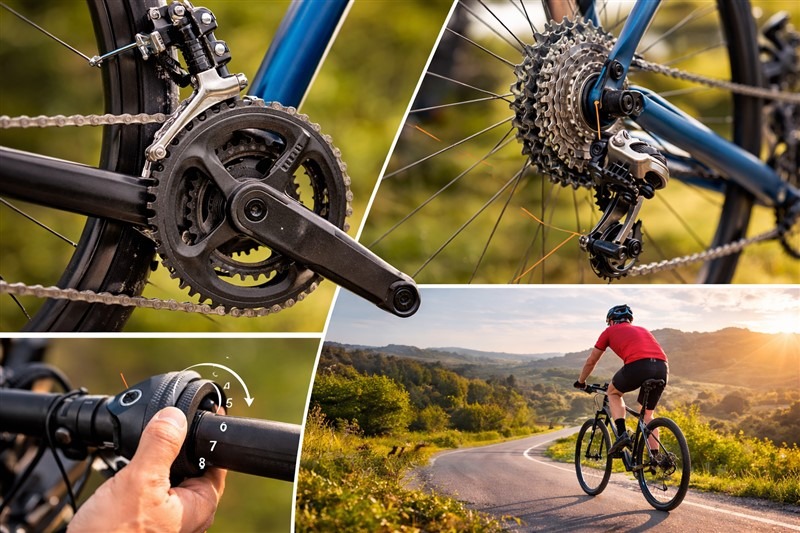
Modern bicycles use a drivetrain system consisting of several components that transfer your pedalling energy to the rear wheel.
Most bikes change gears by moving the chain between different-sized cogs or chainrings using devices called derailleurs.
When you shift gears using the levers on the handlebars, the derailleur pushes the chain onto a different gear. Larger gears make pedaling easier, while smaller gears make it harder but faster.
The principle behind bicycle gears is simple:
Different gear sizes change how many times the rear wheel rotates for each pedal revolution.
The Bicycle Drivetrain Explained
The drivetrain is the collection of components that convert pedalling motion into forward movement.
Key Components of Bicycle Gears
| Component | Description | Function |
|---|---|---|
| Chainrings | Large gears attached to the pedals | Provide primary gear changes |
| Cassette | Cluster of gears on the rear wheel | Fine-tunes pedaling resistance |
| Fine-tunes pedalling resistance | Connects chainrings and cassette | Transfers power to the wheel |
| Front Derailleur | Mechanism near the pedals | Moves the chain between front gears |
| Rear Derailleur | Mechanism at the rear wheel | Moves the chain across cassette gears |
| Shifters | Controls on the handlebars | Allow the rider to change gears |
These parts together form the bicycle gearing system, enabling riders to adjust resistance and maintain efficiency while riding.

Understanding Gear Ratios
One of the most important concepts in cycling is the gear ratio.
A gear ratio determines how many times the rear wheel turns for each full revolution of the pedals.
To calculate a gear ratio:
Gear Ratio = Chainring Teeth ÷ Rear Cog Teeth
Example:
- Front chainring: 50 teeth
- Rear cog: 11 teeth
Gear ratio:
50 ÷ 11 = 4.55
This means the rear wheel rotates 4.55 times for every pedal revolution.
The higher the ratio, the faster the bike travels per pedal stroke.
High Gears vs Low Gears
Understanding when to use different gears is key to efficient cycling.
Low Gears (Easier Pedalling)
Low gears combine:
- Small chainring at the front
- Large cog at the back
These gears require less force and are best used for:
- Climbing hills
- Starting from a stop
- Riding into strong winds
Low gears allow you to spin the pedals quickly while maintaining manageable effort.
High Gears (Harder Pedalling)
High gears combine:
- Large chainring at the front
- Small cog at the rear
These gears are used when:
- Riding downhill
- Cycling on flat terrain at higher speeds
- Sprinting
Although harder to push, high gears allow you to travel farther with each pedal stroke.
Types of Bicycle Gear Systems
Not all bikes use the same gear systems. The type of gearing depends on the bike’s design and intended use.
Below are the most common systems used today.
Derailleur Gears
The most widely used system is the derailleur gear system, found on road bikes, hybrid bikes, gravel bikes, and mountain bikes.
This system uses derailleurs to move the chain between gears.
Advantages include:
- Wide gear range
- Lightweight design
- Efficient power transfer
- Precise gear adjustments
Modern bikes may feature between 8 and 12 gears on the cassette, giving riders many gearing options.
Hub Gears
Some bikes use internal hub gears, where the gearing mechanism is enclosed inside the rear hub.
Common on commuter and city bikes.
Advantages:
- Low maintenance
- Protected from dirt
- Ability to shift while stationary
However, hub gears usually offer fewer gear choices compared to derailleur systems.
Below is a clear reference table of the most popular internal hub gears used on bicycles, including the number of gears and their typical gear range (the percentage difference between the easiest and hardest gear). Gear range is important because it determines how well a hub can handle steep climbs and fast riding. (hubgear.net)
Popular Internal Hub Gears (Comparison Table)
| Hub Gear System | Manufacturer | Number of Gears | Gear Range | Typical Use |
|---|---|---|---|---|
| Rohloff Speedhub 500/14 | Rohloff | 14 | 526% | Touring, expedition, endurance cycling |
| Kindernay XIV | Kindernay | 14 | 543% | High-end touring and MTB |
| Shimano Alfine 11 | Shimano | 11 | 409% | Commuting, touring, trekking |
| Enviolo N380 (NuVinci) | Enviolo | Continuously variable | ~380% | City bikes, e-bikes |
| Shimano Alfine 8 | Shimano | 8 | 307% | Urban commuting |
| Shimano Nexus Inter-8 | Shimano | 8 | 307% | City and commuter bikes |
| Sturmey-Archer 8-Speed (X-RF8) | Sturmey-Archer | 8 | ~325% | Commuting and leisure riding |
| Shimano Nexus 7 | Shimano | 7 | ~244% | Urban commuting |
| Shimano Nexus 5 (E-Bike) | Shimano | 5 | ~263% | E-bikes and cargo bikes |
| Sturmey-Archer 5-Speed | Sturmey-Archer | 5 | ~256% | City bikes |
| Sturmey-Archer 3-Speed | Sturmey-Archer | 3 | ~177% | Classic commuter bikes |
| Shimano Nexus 3 | Shimano | 3 | ~186% | Traditional city bikes |
What “Gear Range” Means
Gear range is expressed as a percentage difference between the lowest and highest gear.
Example:
- A 300% gear range means the highest gear is 3 times harder than the lowest gear.
- A 526% gear range means the highest gear is 5.26 times harder than the lowest gear.
The Rohloff Speedhub, for example, has a 526% range, meaning its top gear is more than five times higher than its lowest gear.
This is comparable to many derailleur systems but with fewer redundant gears.
Gear Range Comparison (Simple Guide)
| Gear Range | Riding Terrain |
|---|---|
| 170–200% | Flat urban riding |
| 250–320% | Moderate hills |
| 350–420% | Hilly terrain and touring |
| 500%+ | Expedition touring and mountain riding |
This is why:
- 3-speed hubs are ideal for city riding.
- 8–11 speed hubs suit commuters and recreational riders.
- 14-speed hubs are popular for touring, endurance cycling, and heavy loads.
Key Hub Gear Manufacturers
The internal hub gear market is dominated by a few major companies.
Shimano
The largest manufacturer of hub gears.
Popular models:
- Nexus series
- Alfine series
These hubs are widely used on commuter, hybrid, and trekking bikes.
Rohloff
A German manufacturer known for extremely durable, high-end hubs.
The Rohloff Speedhub 500/14 is considered the benchmark hub gear for expedition touring bikes thanks to its wide range and evenly spaced gears.
Sturmey-Archer
One of the oldest hub gear manufacturers, dating back to 1902.
Their classic 3-speed hubs were once the standard for British commuter bikes.
Enviolo (formerly NuVinci)
Unlike traditional hubs, Enviolo hubs use a continuously variable transmission (CVT).
This means:
- No individual gears
- Smooth transitions between ratios
- Popular on electric bikes and urban commuters
Choosing the Right Hub Gear
When selecting an internal gear hub, consider three main factors.
1. Terrain
Flat city riding requires far less gear range than mountain touring.
Example:
- City commuting → 3-8 gears
- Mixed terrain → 8-11 gears
- Touring and endurance riding → 11-14 gears
2. Maintenance
Hub gears are sealed inside the hub, meaning they:
- Require less maintenance
- Stay cleaner than derailleur systems
- Work well in bad weather
However, repairs can be more complex if internal parts fail.
3. Riding Style
| Riding Style | Recommended Hub |
|---|---|
| City commuting | Nexus 3, Nexus 7 |
| Urban and hybrid bikes | Alfine 8 |
| Touring | Alfine 11 |
| Expedition / long-distance touring | Rohloff 14 |
Hub Gears vs Derailleur Gears
Many cyclists wonder how internal hub gears compare to derailleur systems.
| Feature | Hub Gears | Derailleur Gears |
|---|---|---|
| Maintenance | Low | Higher |
| Weather resistance | Excellent | Moderate |
| Gear range | Moderate–wide | Very wide |
| Efficiency | Slightly lower | Slightly higher |
| Ease of use | Very simple | More complex |
Hub gears are especially popular for commuting, touring bikes, and belt-drive bicycles.
Final Thoughts on Hub Gears
Internal hub gears provide a reliable and low-maintenance alternative to derailleur systems. From the classic 3-speed commuter hub to the 14-speed Rohloff touring hub, each system offers a different balance of simplicity, durability, and gear range.
For most cyclists:
- 3–7 gears work well for city riding
- 8–11 gears suit commuting and recreational cycling
- 14 gears provide enough range for serious touring and endurance riding
Choosing the right hub gear depends on where and how you ride, but understanding the number of gears and gear range will help you select the best system for your bike.
Single-Speed Bikes
Single-speed bikes have only one gear ratio.
These bikes are simple, lightweight, and easy to maintain but offer limited versatility.
They are popular for:
- Urban commuting
- Track cycling
- Minimalist riders
However, riding hills can be more challenging without multiple gear options.
How Many Gears Does a Bike Have?
Many bikes advertise a certain number of gears, such as 18-speed or 21-speed.
This number is calculated by multiplying the number of chainrings by the number of cassette cogs.
Example:
| Chainrings | Cassette Gears | Total Gears |
|---|---|---|
| 3 | 7 | 21 |
| 2 | 10 | 20 |
| 1 | 12 | 12 |
However, the number of gears doesn’t necessarily equal the number of unique gear ratios. Some combinations overlap or should be avoided.
The most important factor is gear range, not simply gear quantity.

When Should You Change Gears?
Using bicycle gears effectively helps you maintain an efficient pedalling rhythm.
Cyclists often aim to maintain a steady cadence between 70 and 90 revolutions per minute (RPM).
Here are common situations where you should shift gears.
Climbing Hills
When approaching a hill:
- Shift into lower gears
- Maintain a steady pedalling cadence
- Avoid grinding slowly in a high gear
Lower gears reduce strain on your legs and help you climb efficiently.
Riding on Flat Roads
When riding on flat terrain:
- Use the middle gears
- Maintain smooth cadence
- Adjust gears as the wind or speed changes
Flat terrain often requires small adjustments rather than large gear changes.
Descending
When riding downhill:
- Shift into higher gears
- Increase speed with fewer pedal rotations
However, always maintain control and avoid spinning the pedals excessively fast.
How to Change Gears Properly
Shifting gears correctly improves performance and protects your bike components.
Follow these basic rules.
1. Shift While Pedalling
Gears only change when the chain is moving.
Always shift while pedalling lightly.
Reducing pressure slightly helps the chain move smoothly between gears.
2. Anticipate Terrain Changes
Try to shift gears before you reach a hill rather than halfway up.
This prevents excessive strain on the drivetrain and helps maintain momentum.
3. Make Small Adjustments
Most cycling situations require only small gear changes.
Use the rear cassette for fine adjustments and the front chainrings for larger changes.
Avoid Cross-Chaining
One common beginner mistake is cross-chaining.
This happens when the chain runs diagonally across the drivetrain.
Examples include:
- Large chainring + large rear cog
- Small chainring + small rear cog
Cross-chaining causes:
- Excessive drivetrain wear
- Reduced efficiency
- Noisy pedaling
Instead, use balanced gear combinations to maintain a straight chain line whenever possible.
Understanding Cadence in Cycling
Cadence refers to how quickly a rider spins the pedals, measured in revolutions per minute (RPM).
Efficient cyclists maintain a consistent cadence rather than pushing heavy gears slowly.
Benefits of maintaining proper cadence include:
- Reduced muscle fatigue
- Improved endurance
- More efficient energy use
- Better cardiovascular performance
Using the correct gear helps you maintain this optimal cadence.
Common Beginner Gear Mistakes
New cyclists often struggle with gears. Here are common mistakes to avoid.
Staying in One Gear
Many beginners forget to use all the available gears.
Changing gears frequently helps maintain efficiency and prevents muscle fatigue.
Pedalling Too Hard
Grinding a large gear at low cadence can quickly exhaust your legs.
Instead, shift into easier gears and spin faster.
Shifting Under Heavy Load
Changing gears while pushing hard on the pedals can damage components.
Ease off the pressure briefly during shifts.
Tips for Learning Bicycle Gears Quickly
If you’re new to cycling, learning gears may feel confusing at first.
These simple tips will help you master them quickly.
Practice on Flat Roads
Start riding on flat terrain and experiment with different gears.
Notice how each change affects pedalling effort.
Ride on Varied Terrain
Hills naturally teach you when to shift gears.
Practice anticipating terrain changes.
Listen to Your Body
If pedalling feels too easy or too hard, adjust the gear.
Your legs are the best indicator of when to shift.
Why Bicycle Gears Matter
Understanding bicycle gears can dramatically improve your cycling experience.
Proper gear use helps you:
- Ride longer distances
- Climb hills more easily
- Reduce fatigue
- Maintain consistent speed
- Protect your bike components
Whether you ride for commuting, fitness, touring, or endurance cycling, learning how to use gears efficiently will make every ride smoother and more enjoyable.
Final Thoughts
For many beginners, bicycle gears initially seem complicated. However, once you understand the basic principles of gear ratios, cadence, and shifting techniques, using them becomes second nature.
Think of gears as tools that help you adapt to the terrain and maintain a comfortable pedaling rhythm. The more you ride, the more intuitive shifting will become.
Remember:
- Use low gears for hills
- Use high gears for speed
- Maintain a steady cadence
- Shift before terrain changes
Mastering your bike’s gears will make cycling easier, faster, and far more enjoyable.